
Cuba is in the headlines these days, so I thought I would republish this old blog from 2017. I visited in 2016 and got to see Castro’s funeral procession.
I don’t know how much of this has changed, but I know I am livid about how our government has decided to pick on them. I found the people industrious, friendly, and not afraid to speak out against the government. One woman who was our bus tour guide showed us the National Hotel of Cuba but warned us ot to stay there. The service was terrible, she explained. At that time, Cuba was experimenting with free enterprise. The government hotel bars couldn’t even scrounge up a martini glass, but the privately run ones would give you anything they wanted, and entertainers in these establishments happily took $1 bills as tips.
The Cuban professor who was the lecturer on our ship (Americans could only tour if they were on an educational tour, and I had a certificate that I had to get signed) said the government knew Communism was not healthy for the economy and was sanctioning entrepreneurial enterprise.
Rather than trying to bring them down by bullying others into not trading with them, we should open trade. That is a win-win. Trying to force them into capitulation is cruel and costly. There’s lots of money for American businesses to make in Cuba if only we would lift the sanctions.
I’d go back in a heartbeat and take my grandchildren. It was an amazing place.
From 2017:
CUBA KNOWS ABOUT THE OUTSIDE WORLD
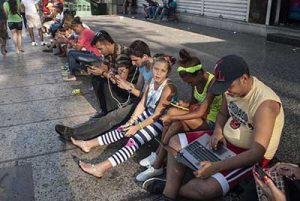
Cubans know quite a bit! According to Havana University professor Dr. Jorge G. Arocha, 31% of the population is online at Wi-Fi hot spots set up by the government in 2015. Seeing Cubans huddled in parks or outside government-run buildings staring at smart phones is not uncommon. Only university employees with over 10 years of service are allowed internet connections at home–dial-up only. The privilege is not cheap. One hour of a Wi-Fi connection costs 2 Cuban Convertible Pesos (CUCs), which is equivalent to $2.00. Keep in mind that the average Cuban earns between 20 and 50 CUCs a month.
Then, there is what is called El Paquete (the packet), an illegal service that is Cuba’s largest employer. Weekly, employees in large institutions download massive amounts of data that is compiled and uploaded outside of Cuba, including TV series (think Game of Thrones), magazines, news sources, sports, movies, and books. They then sell the data to others, downloading it via a USB drive. Those individuals, in turn, sell the information. The packet can eventually cost 1CUC.
CUBA GETS LOTS OF HELP FROM FAMILY AND FRIENDS
How do Cubans manage? As many as 35% of Cubans receive money from Cuban Americans and many others receive money from relatives outside the United States. More are working in the private sector which pays better than the government. Lastly, all Cubans receive free medical care and cheap food through the use of food rationing coupons. Because the coupons do not provide adequate food for one individual, many Cubans fail to report when a relative is deceased and continue to collect that individual’s food ration.
Sign up on www.mariewatts.com to receive future Stories About Life delivered to your email address or read more stories by clicking here.
Sources:
“Lectures by Dr. Havana University professor Dr. Jorge G. Arocha, December 3-8, 2016.
The Cuban Internet” downloaded from https://www.foreignaffairs.com/articles/cuba/2016-04-19/cuban-internetor on January 6, 2017.
“The Package (El Paquete) Is Illegal But It’s Cuba’s No. 1 Employer” downloaded from http://abcnews.go.com/International/package-el-paquete-illegal-cubas-number-employer/story?id=33279812.
Photo: Cubans at a Wi-Fi hotspot. Havanatimes.org












Recent Comments