
 I have a love-hate relationship with Christmas Cards. Or, to be honest, more on the hate side, mainly because it causes me intense guilt. Guilt, you say? It’s a convoluted story, but I’ll try to explain.
When my daughters were young, I was determined to provide them with the best Christmases ever. I baked cookies to give as gifts to the neighbors and even made my Dad’s great aunt’s fruit cake. And, of course, I sent out Christmas cards. In their preschool years they were photos of the girls. One I remember was in matching dresses made by their grandmother.
I succumbed to the most horrendous stress attack one Christmas, which led me to stop baking and sending Christmas cards. But, amazingly, the guilt of not mailing cards has remained for a good forty years! The truth is, I really want to reach out to friends to wish them Happy Holidays, but the thought of distress stops me cold.
Then, this week, after serving as a docent in the girls’ bedroom at the historic Kreische Brewery State Historic Site, where antique Christmas cards were on display, I began to think about the villains who wrecked my life.
CHRISTMAS CARDS ORIGIN
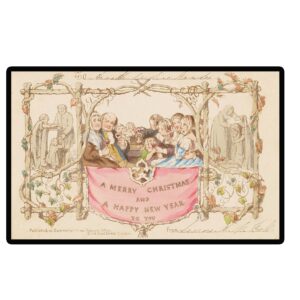
The first Christmas card was mailed in 1843 in England by Sir Henry Cole, who was inspired by the relatively cost-effective system of printing postcards and using the penny post. His picture caught some flak, however, because the temperance movement frowned on a picture appearing to show children drinking wine. At least pictures showing others helping the poor rimmed the merrymaking.
The idea was slow to catch on until….
CHRISTMAS CARDS EVOLUTION
Prussian immigrant Louis Pang began producing the first commercially available Christmas cards in the U.S. in 1875, using a new process called chromolithography. This technique allowed him to make multicolor prints in lithography.
To assure his cards would match his vision as works of art, he held design competitions with monetary prizes. Judges included painters, an architect, and a designer, Louis Comfort Tiffany. Typically, they contained nature scenes or animals.
One other twist that dug the Christmas card knife deeper in me was when, in 1915, the Hall brothers began printing Christmas postcards. Soon, they created the folded card mailed in an envelope. Nice! You could write a small note, but did not have to wrack your brain to produce a full letter. They still subjugate us today via the name Hallmark.
CHRISTMAS CARDS WITH LETTERS
But some people are never happy. The Christmas letter appeared in 1948. By the 1960s, when photocopying became widespread, these letters proliferated. Family achievements and milestones were common. Come to think of it, I can’t remember getting a Christmas letter filled with negative information.
According to the Smithsonian Magazine:
Ann Landers, in her syndicated advice column, published complaints about the so-called “brag rags,” such as one first printed in 1968 asking why “normally intelligent people seem to take leave of their senses at Christmas.” Umbrage, of course, was taken. “How can you, in good conscience, encourage people to not share their happy news in holiday letters?” chided Pam Johnson, the founder of the Secret Society of Happy People. “We live in a popular culture that all too often makes people feel rotten for being happy and even worse for sharing it….Happy moments are good things that need to be shared more—not less.” As culture wars go, this was pretty tame, but an Emily Post Institute survey showed that Americans were sharply divided, with 53 percent approving of the holiday letter and 47 percent hating it.
LAST THOUGHTS ABOUT CHRISTMAS CARDS
Of course, these days you can always make your own. YouTube is full of ways to mass-produce cards or make a simple, one-of-a-kind watercolor card. But you won’t be getting a work of art from me. I’m too stressed out working on my next novel to take the time.
But I do want to wish everyone “Happy Holidays” in the best way I know, which is through this blog!
Consider this my Christmas Letter to you!
Sign up on www.mariewatts.com to receive future Stories About Life delivered to your email address or read more stories by clicking here.












Recent Comments