 What’s happening in Cuba is heartbreaking, and I’m pleased to welcome my Women’s Fiction Writers Association friend, Elizabeth Huergo, as a guest blogger to update us on the situation. She originally posted this article on Writer Unboxed on July 13, 2026.
WHERE IS CUBA?
South of the Buoy
At the southernmost point of the continental US, about latitude 24.5 and longitude 81.7, you will find an anchored buoy, 12-feet tall and 7-feet wide, a tourist attraction for visitors to Key West. Standing there, you might imagine drawing a line due south, a zip line that allows you to glide and then drop magically into L’Habana, the city that has fascinated so many writers. Erected in 1983, the buoy was the brainchild of a Key West politician hoping to lure more tourists to the area. At one point, the buoy included a factoid that disappeared and then reappeared on a separate placard (positioned nearby) that announced: “Cuba lies 90 miles south.” You shouldn’t always trust buoys—or placards, for that matter. The map is not the territory, as the philosopher Alfred Korzybski warned us in the 1930s. Maps are oversimplifications of complex realities.
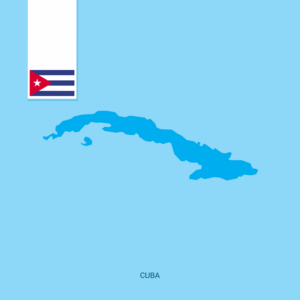
In fact, if you could draw that line between continent and island, your first glimpse of Cuba would be the northern coastline of Matanzas Province, not L’Habana Province or the city of L’Habana itself. The world does not lie flat on the surface of our imagination. Turns out the factoid “90 miles to Cuba” is an oversimplification compounded by the fallacy that the part (the capitol city of L’Habana) is the whole of Cuba. The closest point between the continental US and Cuba actually lies southwest of the buoy, not directly south.
The prejudices we all carry within us are maps we use to navigate this world. These prejudices determine what we see and how we interpret what we see. Some people actively work to present us with overly simplified maps, maps that serve their own prejudices and interests. We often idolize those people because thinking is hard work and oversimplification makes some level of understanding immediately available, and the pace of life is so frenetic that some thinking is better than none, isn’t it? Haven’t you heard? Immigrants are eating our pets, raping and murdering the people we love.
WHAT DO YOU KNOW ABOUT CUBA?
Speaking as an immigrant, a Cuban political refugee, I am always surprised how little people here know about Cuba. Ask the average American about the economic embargo against Cuba (imposed in 1960 and expanded in 1962 by President Kennedy) and you get a blank stare in response; that or a joke about “fuzzy whiskers” since all Cuban history, as represented in US media, begins and ends with a caricature of Fidel Castro, not the right-wing Batista government installed and managed by the US; not the grass-roots democratic movements razed by US economic interests; not Guantanamo, the land seized and militarized. Nope, just fuzzy whiskers.
Embargo is an interesting word that derives from the Latin imbarricāre, which means “to bar, barricade, obstruct.” At some point the word appears in Spanish in the form of the verb embargar, which means “to seize,” “to hinder,” “to obstruct,” or “to place under legal restraint.” By the time the English get hold of it in the late 16th century, embargo is an order preventing ships from leaving port. Around 1590, a king or government would place an embargo on ships in a harbor, literally preventing them from departing because, in war, an embargo makes merchant vessels available for deployment and prevents supplies from reaching an enemy. Today the word embargo refers to a government-imposed legal prohibition backed by the force of law.
Then and now, at its core, an embargo still evokes the idea of placing a barrier in someone’s path, preventing the free movement of goods and people. The expanded US embargo of 1962 against Cuba, for example, bars most US exports and Cuban imports. It limits financial transactions and US investments in Cuba. It limits most travel to Cuba. President Eisenhower, a supporter of Batista, a right-wing dictator as brutal and self-serving as Saddam Hussein, was unwilling to accept Castro as a legitimate leader who would keep US interests at heart. Castro, already well left of center by the time he descended from the Sierra Maestra, aligned himself with the Soviet Union and nationalized U.S.-owned businesses and property in Cuba, refusing to compensate anyone for the losses.
CUBA AND THE EMBARGO
The embargo, intended to pressure the Cuban government economically and politically, is a failed 64-year long experiment. Yet in January 2026, the Trump Administration piled on another embargo. (Forgive me! No one uses the word embargo to describe what has been unfolding for nearly seven months.) For the past seven months, the Trump Administration has sought to bar, barricade, obstruct, seize, hinder, and/or place under legal restraint all petroleum shipments to Cuba from other countries, using the threat of U.S. tariffs and sanctions against those countries or companies.
Cuba is a country rich in nickel, iron ore, cobalt, chromium, silica, copper, salt, and timber. One-third of the island’s land is arable, and it is fertile soil capable of producing more than one harvest per year. But it needs petroleum to generate electricity, to operate public transportation, and to convey agricultural products into its cities. By barring the arrival of petroleum tankers, the Trump Administration has intentionally exacerbated already difficult economic conditions.
CURRENT CONDITIONS IN CUBA
When I ask my family in Cuba what conditions are like right now, they reluctantly describe nationwide blackouts that last two or three days, followed by three or four hours of electricity. Potable water is getting difficult to find because generators simply aren’t working. Old generators have been destroyed by the frequent power surges. There is no transportation of food from farms to cities. There are no refrigerators that can safely store food. Hospitals are turning away patients, unable to offer obstetric care or critical surgeries.
It’s a barbaric war crime. What the English did to the Irish; what the Assyrian, the Mongol, the Roman, and the Ottoman Empires did to people they were determined to subdue; what the Nazis did to resisters in occupied territories; what the Soviet Union did to suppress Ukrainian nationalism—this is what the US has been doing intentionally since January of this year, using starvation as a weapon of war. The US Administration describes a straight line between two points: regime change. But for anyone clear-eyed and willing to look, the “great-circle route” of history reminds us that children and pregnant women and old people are dying from the lack of clean water, food, and medicine. There is indeed a lot of violence to see here. I would not judge you for flinching or changing the channel.
“Violence,” anthropologist David Graeber argues, “especially structural violence, where all the power is on one side, creates ignorance.” And violence, Graeber adds, has always been the favored recourse of the stupid: it is the one form of stupidity to which it is almost impossible to come up with an intelligent response. It is also of course the basis of the state” (Fragments of an Anarchist Anthropology). In an especially cynical age, a violent war tactic is framed as an economic one, as if there were an honorable form of raping and pillaging: “I do believe I’ll have the honor of taking Cuba,” President Trump reflected on 26 March in an Oval Office interview. By radically limiting access to water, food, medicine, and transportation during the searing heat of a tropical summer, Cuba is “gonna [sic] fall pretty soon,” he said.
LEARNING MORE ABOUT CUBA
If you want to learn about Cuba, please don’t read Hemingway. Read Hemingway to learn about an important US writer, a conscious stylist who has influenced the syntax and cadences of American English; a storyteller who teaches us something about the anguish of war and the silent landscapes between men and women. Instead, read José Lezama Lima’s essay collection La expresión americana or his novel Paradiso. Read Alejo Carpentier’s Explosion in a Cathedral or The Kingdom of This World or The Lost Steps or The Chase or Reasons of State and revel at the intersection of sound and sense by a brilliant musicologist. Read Guillermo Cabrera Infante, Reinaldo Arenas, Severo Sarduy, Leonardo Padura, Abilio Estévez, Antonio José Ponte, Ena Lucía Portela, or Pedro Juan Gutiérrez, to name just a few Cuban writers.
If you prefer to read history, try the scholarly Cuba: Between Reform and Revolution or On Becoming Cuban: Identity, Nationality, and Culture, both by Louis A. Pérez Jr. Read Ada Ferrer’s Cuba: An American History, in which she argues that the nation’s history cannot be understood separate from US history. There is also the encyclopedic Cuba: The Pursuit of Freedom (originally published as Cuba: A History) by Hugh Thomas; and Manuel Moreno Fraginals’ The Sugarmill, which explores capitalism’s roots in slavery.
Just, please, don’t rely on buoys and placards.
Thanks, Elizabeth!
Sign up on www.mariewatts.com to receive future Stories About Life delivered to your email address or read more stories by clicking here.










Recent Comments